Shopping cart

CALL TODAY (248) 238-3811

Infinity Pools | Pools Construction | Pool Renovations | Pool Maintenance

From Installation to Swim: The Complete Guide

From Installation to Swim: The Complete Guide

If you are one of the many First-Time Pool Buyers, understanding how to start your pool the right way is very important. Learning about pool first time chemicals will help you keep your water clean and safe, especially if you are a first time pool owner who wants simple steps to follow. This guide explains everything you need to know about first time pool chemicals and what to expect from the moment of Installation to Swim so you can enjoy a smooth and confident start to owning your pool.

Pool First Time Chemicals & Water Chemistry Basics

As soon as your pool is filled (even before your first swim) understanding and using pool first time chemicals correctly is essential. The right chemistry keeps water safe, clear, and comfortable.
Why pH and Alkalinity Matter
  • pH level: This measures how acidic or basic your pool water is. The ideal range is typically between 7.2 and 7.6.
  • Alkalinity: This acts like a buffer for pH. Proper alkalinity helps prevent pH swings that can irritate skin or eyes, cause cloudiness, or damage pool surfaces and equipment.
Balancing both pH and alkalinity helps chlorine (or whatever sanitizer you use) work effectively.

How to Raise or Lower pH: A Guide for First-Time Pool Owners

Raising pH (If pH is too low)

If your water test shows pH below 7.2:
  • Use soda ash (sodium carbonate) for a quick and stronger pH boost.
  • For a gentler, slower boost (also raising alkalinity) use baking soda (sodium bicarbonate). For example: about 3–4 lbs of baking soda per 10,000 gallons can raise pH if it’s under 7.2.
  • Always run your pool pump and filter while adding chemicals so they circulate evenly and dissolve properly.

Lowering pH (If pH is too high)

If pH goes above ideal (say over 7.8) your sanitizer may not work well, and water may feel uncomfortable or cause scale buildup. 
  • Use muriatic acid or pH decreaser / dry acid to bring pH down gradually.
  • Always add acid slowly, preferably diluted, and while the pump is running to ensure even dispersion. Overcorrecting can lead to overly acidic water and other problems.

Maintaining Alkalinity

If alkalinity is low (say under 80–100 ppm), your pool is prone to unstable pH levels. Use baking soda to raise alkalinity without drastically shifting pH.
Wait several hours after adding chemicals before retesting water, to ensure readings settle properly.

Filling Pool for the First Time & Getting Started Right

For first-time pool buyers, the moment you fill the pool for the first time is exciting, but you’ll want to check these details before letting anyone swim:
  • Confirm water volume and pool size. This helps calculate correct chemical dosages.
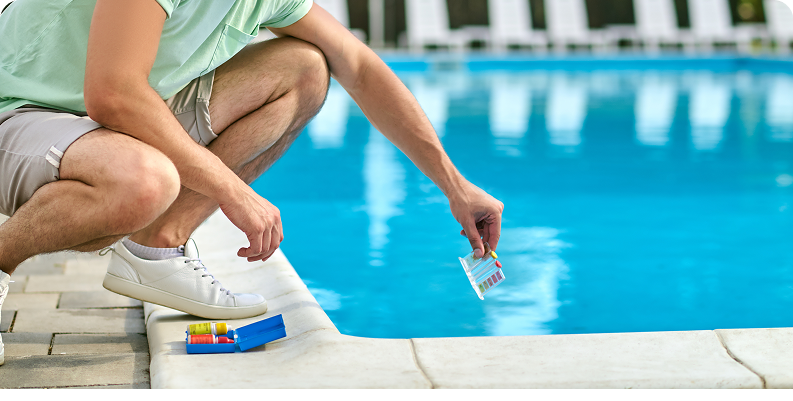
  • Test water for pH, alkalinity, hardness, and chlorine (or sanitizer). Balance pH/alkalinity first.
  • Add stabilizers, chlorine/shock, and other required chemicals according to manufacturer instructions.
  • Run pump and filter continuously for the first 24–48 hours to circulate chemicals and ensure water clarity.
  • Retest before first swim; clear, balanced water is safer and more comfortable.
This approach helps avoid problems like cloudy water, skin or eye irritation, and damage to pool surfaces.

Tips for First Time Pool Owners: Maintenance & Smart Buying

  • Don’t overcomplicate chemical use: focus on chlorine (or sanitizer), pH, and alkalinity. These three are key. Extra chemicals (like clarifiers or phosphate removers) are usually only needed when you see a specific problem. Many experienced pool-owner communities agree on keeping it simple.
  • Retest pool water regularly (at least once a week), especially after heavy use, rain, or significant evaporation.
  • Stick to properly dosing guidelines. Over-dosing acid or alkalinity can destabilize water balance and cause corrosion or scaling.
  • When budgeting as a first-time pool buyer, remember that the installation cost (shell, excavation, equipment) is only part of the overall expense. Maintenance (chemicals, electricity, cleaning) is ongoing.

Conclusion

Becoming a first time pool owner is exciting, and with the right information, you can make smart decisions from installation to maintenance. For first-time pool buyers, understanding pool first time chemicals, proper pH and alkalinity balance, correct initial filling, and consistent upkeep are all essential for a safe, clean, and enjoyable pool.
With the guidance in this post, you're equipped to start your pool journey with confidence, from building the pool to swimming in crystal-clear water.

Comments are closed